
The Economic Case For UDWTM Obesity Medicine


The UDW platform greatly increases support for better outcomes by creating the real behavioral changes needed to lose weight and promote better health. UDW can also can monitor biometric data that tracks with multiple obesity-related medical problems like pre-diabetic and clinical Type 2 Diabetic states.
Because extensive research confirms that coaching, positive messaging and peer support all play such a central role in successful obesity treatment programs, we’re confident that having real-time patient biometrics available will greatly improve the obesity coach’s effectiveness and patient self-awareness and help create the behavioral changes that we are confident will lead to far better patient outcomes than are provided by the other more limited technology solutions currently in use.
This user-friendly data-rich platform will bring major improvements to patient monitoring and outcomes for obesity and obesity-related health issues, including a high potential for reversal of the need for treatment and medications in obesity and related conditions like Diabetes.
We believe that weight loss and the adoption of better behavioral patterns can produce very significant results in many of the obesity-associated conditions.
REDUCING THE COSTS OF OBESITY

In the 10 US cities with the highest obesity rates, the direct costs connected with obesity and obesity- related diseases are roughly $50 million per 100,000 residents.
If these 10 cities cut their obesity rates down to the national average, the combined savings to their communities would be $500 million in health care costs each year.
(Harvard Business Review 2020)
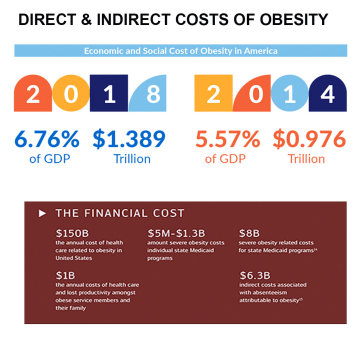
The economic and social cost of obesity in America is at an all-time high and continues to rise.
We estimate its economic cost to be roughly 6.76 percent of gross domestic product (GDP) in 2018.
The current pandemic is likely to raise this cost even higher.
(Milken Institute: 2020)
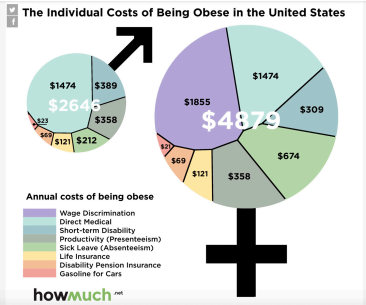
“Total healthcare costs for obese individuals are 15 times higher than total costs for overweight individuals, irrespective of gender and employment status.”
George Washington University 2020
THE HUMAN SIDE OF OBESITY COSTS
“When you look at the top two causes of death in the U.S. — heart disease and cancer — obesity contributes to both.
It’s not only these conditions that we think of as potentially fatal, but obesity also contributes to things like degenerative joint disease, and the sheer weight causes conditions like sleep apnea, pneumonia, and arthritis.
It’s a breathtakingly broad set of things that can be affected.”
Cornell University Medical School 2020
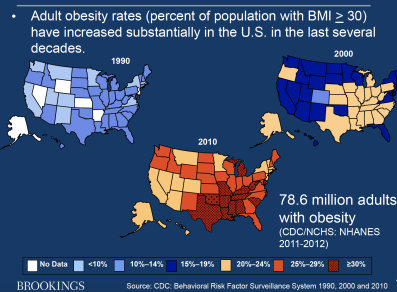
“Our findings suggest with high predictive accuracy that by 2030 nearly 1 in 2 US adults will have obesity and the prevalence will be higher than 50% in 29 states and not below 35% in any state.
We predict that, nationally, severe obesity is likely to become the most common BMI category among women, non-Hispanic black adults, and low-income adults.”
New England Journal of Medicine 2019
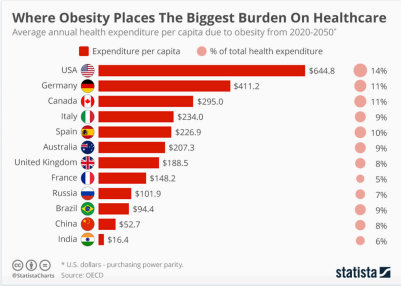

It’s clear that by 2030 obesity will be having an enormous human and economic impact on every part of the us population and the us healthcare system- and the need for UDWTM will grow well beyond 2021